
If your AC is making a sound you’ve never heard before, shut it down at the thermostat and breaker if you notice continuous metallic banging, loud hissing, an electrical buzz paired with a burning smell, or repeated clicking that won’t let the unit start. Any of those point to an urgent mechanical or electrical failure. If you’re hearing something milder, run through the homeowner checks below before you decide whether to call a licensed technician.
TL;DR:
- Banging or clanking noises often indicate urgent mechanical issues, like loose parts or broken compressor components, requiring immediate shutdown and professional inspection.
- Buzzing or humming sounds usually point to failing capacitors or stuck contactors, with persistent noise suggesting electrical faults that need quick repair.
- Repeated clicking during startup indicates electrical starting faults, and a steady hiss signals refrigerant leaks, both necessitating professional diagnosis and service.
- Sounding of squealing, screeching, or grinding often means worn fan motors or bearings, which benefit from early attention to prevent major compressor failures.
- Regular maintenance, including filter replacement and system cleaning, can significantly reduce noise levels and prevent costly repairs over time.
Table of Contents
- What a Normal AC Sounds Like vs. a Noisy Air Conditioner
- The Sound-by-Sound Diagnostic: What Each Noise Means
- How to Safely Check Your AC Before Calling for Service
- When to Shut Down the System and Call a Professional
- Keeping Your AC Quiet: Maintenance That Actually Prevents Noise
- What a Licensed Technician Actually Checks First
- An Honest Take on Diagnosing a Noisy AC
- Getting Your Noisy AC Fixed Without the Guesswork
- Sources
What a Normal AC Sounds Like vs. a Noisy Air Conditioner
A healthy system isn’t silent. You should expect a steady hum while it runs, a single clunk when the compressor kicks on or off, and a soft whoosh of air moving through the vents. Those sounds mean the system is doing its job.
A noisy air conditioner tells a different story, and figuring out where the sound is coming from is half the diagnosis. Walk the house and listen in three places:
- Indoor air handler or closet unit: rattles here often trace back to loose panels or a dirty blower wheel.
- Outdoor condenser: buzzing, screeching, or hissing usually starts here, near the compressor and fan.
- Vents and ductwork: whistling or ticking sounds in the ducts usually mean airflow is restricted somewhere.
Pay attention to timing too. A noise only at startup points to a different problem than one that runs the whole cycle. Never remove an access panel while the unit is powered. Instead, grab a fifteen-second video on your phone. It gives a technician a head start before they even walk in the door.
The Sound-by-Sound Diagnostic: What Each Noise Means
Every AC noise problem has a pattern, and once you know what to listen for, you can usually narrow the cause down before you pick up the phone. Here’s how the most common complaints break down.
- Banging or clanking. This is almost always mechanical: a loose part striking the fan blade, debris caught in the outdoor cabinet, or in worse cases a broken connecting rod inside the compressor. Persistent banging is one of the clearer signs you’re dealing with an urgent air conditioner noise problem. Shut the unit off and don’t restart it until someone inspects it.
- Buzzing or humming. A steady electrical buzz from the outdoor unit is one of the most common complaints technicians hear, and it commonly points to a failing run capacitor or a stuck contactor. A capacitor problem is in fact the single most frequent electrical failure behind a humming outdoor unit that won’t start, and it’s often a same-visit repair. If the outdoor fan isn’t spinning while you hear the buzz, that’s a strong clue the compressor is struggling to start. Treat this as a call-a-pro situation.
- Clicking. One click at startup and one at shutdown is completely normal. Repeated clicking that never resolves into a running system usually means an electrical starting fault, not a random glitch. Turn the system off and call for service if it keeps trying and failing to start.
- Squealing or screeching. This is the sound of a fan motor bearing or belt wearing out, and catching it early is worth real money. Early attention to squealing or grinding bearings usually prevents a full compressor failure down the line. Schedule service soon rather than waiting for it to get worse.
- Hissing or gurgling. A steady hiss near the copper refrigerant lines or the indoor coil is a classic sign of a refrigerant leak, and federal rules under EPA Section 608 mean only a certified technician can legally diagnose and recharge that line. Shut the system down and call.
- Rattling. This one is often good news. Loose screws, a shifted panel, or debris rattling around the cabinet are usually homeowner-fixable causes once the power is off.
- Whistling. A high, thin whistle at the vents almost always means air is being forced through a space too small for it, whether that’s a clogged filter or an undersized return. Check the filter first.
- Grinding or metal-on-metal. This is a motor or blower on its way out. Stop the unit and call a technician before it seizes completely.
Pro Tip: Write down the exact moment you hear the noise: at startup, mid cycle, or on shutdown. That single detail often tells a technician more than a description of the sound itself.
How to Safely Check Your AC Before Calling for Service
Run through this before you call anyone. It takes about ten minutes and rules out the easy stuff.
- Power down safely. Turn the thermostat to off, then flip the breaker for the AC at your electrical panel. Never touch the capacitor or open the outdoor cabinet with power connected.
- Check the filter. A clogged filter is one of the most common causes of whistling and airflow strain. Replace it if it’s visibly gray or hasn’t been swapped in the last 90 days.
- Inspect vents and returns. Make sure furniture or rugs aren’t blocking return grilles, and that supply vents are open.
- Look outside. With power off, clear leaves, grass clippings, or debris from around the condenser. Check that the unit sits level on its pad and the fan blades aren’t visibly bent.
- Try the reset. Leave the breaker off for one to two minutes, then restore power. A brief power cycle can clear minor control glitches, though a noise that returns immediately points to a real mechanical or electrical issue.
- Record the details. Note your unit’s model number and approximate age, describe the sound, and keep that short video handy.
When to Shut Down the System and Call a Professional
Some sounds don’t leave room for troubleshooting. Shut the AC off immediately if you hear any of the following:
- Continuous, escalating banging from the outdoor unit
- A high-pressure hissing or screaming sound, especially paired with weak or no cooling
- Any electrical buzzing accompanied by a burning smell
- Repeated clicking where the system never successfully starts
Modern outdoor units typically run around 50 to 65 decibels, close to a normal conversation. A unit that’s suddenly noticeably louder than that, even without a distinct new noise, is often the first sign of worn bearings or loose hardware developing into something bigger.
These situations carry real risk: electrical faults can spark a fire, refrigerant exposure is hazardous, and running a struggling compressor often destroys it completely, turning a repair into a full system replacement. Shut the unit off at the thermostat and breaker, and don’t attempt a restart.
On cost, a capacitor or contactor replacement typically runs on the low end of AC repairs, while a failing fan motor sits in the middle. Compressor replacement or full system swap sits at the top of the range, since that component is often the most expensive part of the unit. Getting a same-visit fix instead of a replacement usually comes down to catching the noise early, which is why an early diagnostic visit tends to cost far less than waiting for total failure. Before you call, have your model number, the unit’s age, your video, and any past service records ready. It shortens the visit and often the bill.
Keeping Your AC Quiet: Maintenance That Actually Prevents Noise
Most noisy air conditioning units aren’t victims of bad luck. They’re the result of small maintenance gaps that added up.
- Replace the filter every 60 to 90 days, more often if you have pets or run the system constantly through summer.
- Keep the condenser clear of plants, mulch, and debris, and confirm the pad hasn’t shifted or sunk unevenly.
- Book a seasonal tune-up where a technician tightens panels, checks fan blade balance, inspects wiring connections, and verifies mounting bolts haven’t loosened from vibration.
- Consider a sound blanket around the condenser if noise bothers you daily; done right, it can cut perceived compressor noise by roughly half, though it needs careful fitting around the fan motor to avoid restricting airflow.
Pro Tip: Anti-vibration pads under the condenser feet are one of the cheapest upgrades you can make. They stop the low hum from traveling through a shared wall or patio slab.
What a Licensed Technician Actually Checks First
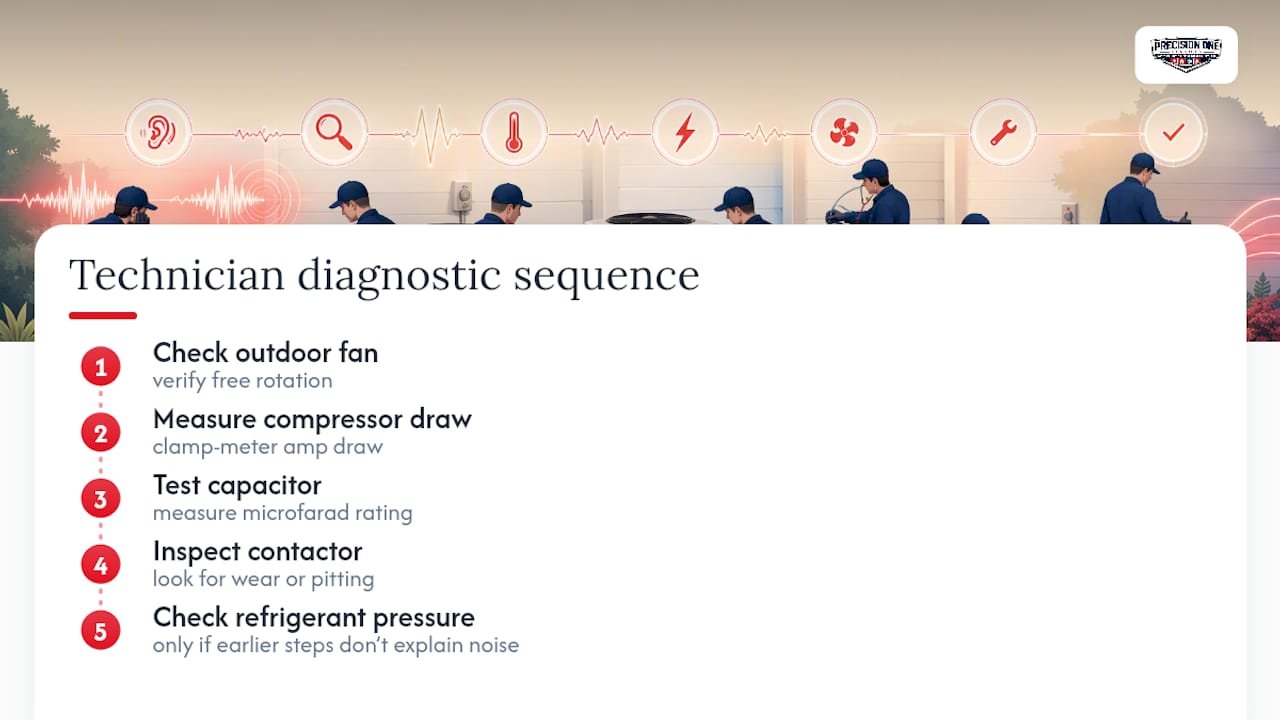
When one of our technicians shows up for a noise complaint, we don’t guess. We run a set sequence: check the outdoor fan for free rotation, clamp-meter the compressor’s amp draw, test the capacitor’s microfarad rating, inspect the contactor, then move to refrigerant pressure if the earlier steps don’t explain the symptom. That order rules out the cheap fixes before anything invasive.
Refrigerant and electrical work isn’t a place for guesswork. Handling refrigerant without EPA Section 608 certification is against federal law, and misdiagnosing a capacitor or contactor issue can damage the compressor permanently. Have your model number, the unit’s age, a short video of the noise, and any recent service history ready when you call. It’s usually the difference between a quick same-visit fix and a second trip.
An Honest Take on Diagnosing a Noisy AC
Most homeowners treat every strange AC noise as a five-alarm emergency, and that instinct costs money. A rattle from a loose panel screw isn’t the same crisis as a hiss near the refrigerant lines, but a lot of advice online flattens every noise into “call someone now,” which pushes people toward unnecessary service calls or, worse, toward ignoring a genuinely urgent sound because they got desensitized by false alarms before.
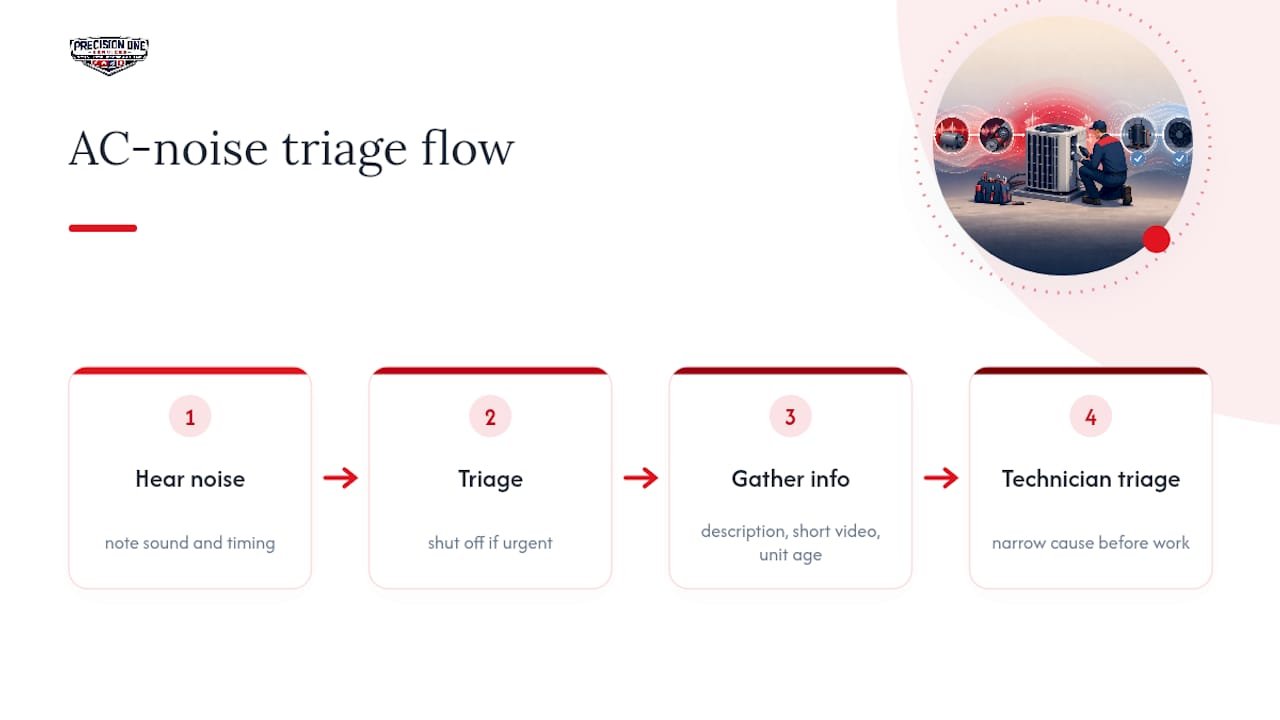
The research backs a simpler approach: sound and timing are remarkably reliable diagnostic tools on their own. A technician who gets a clear description, a short video, and the unit’s age can often narrow the cause before ever touching a screwdriver. That’s the piece homeowners underrate. You don’t need to diagnose the exact fault yourself. You need to describe it well.
What actually matters is triage, not troubleshooting. Learn the handful of sounds that mean “shut it off now,” run the simple checks for everything else, and stop treating every hum as a crisis or every bang as background noise.
— Nick
Getting Your Noisy AC Fixed Without the Guesswork
A reliable local service provider offers an alternative to guessing your way through a noisy AC or waiting days for an appointment window. Some companies offer 24/7 emergency diagnostics with flat-rate pricing quoted before any work starts, enabling a technician to trace that buzz, hiss, or bang back to its source promptly.

On a typical diagnostic visit, technicians often follow a sequence such as checking fan rotation, amp draw, capacitor reading, and refrigerant pressure if needed. A failing capacitor or a loose panel is often a repair that can be completed during the initial visit. A compressor or full system issue typically receives a clear, upfront quote before any work begins. If you’re hearing anything from a persistent buzz to a hard bang from your outdoor unit, get it looked at through our AC repair services page, or check our same-day AC repair options if cooling can’t wait until tomorrow.
Sources
- Why Is My AC Unit Buzzing Every Few Minutes? — BobVila
- AC Making Loud Noise? Identify Sound + Cause + Fix | National HVAC Parts
- AC Making Strange Noises? A Sound-by-Sound Diagnostic for Lowcountry Homeowners
- Air conditioner noise: condenser sound reduction — Family Handyman
Recent Comments