AC short cycling happens when your air conditioner turns on and off in bursts of less than 10 minutes instead of running a full, healthy cycle. A normal cycle lasts 15 to 20 minutes, and anything shorter puts real strain on your compressor while leaving your home warm and clammy. Left alone, it drives up your energy bill and can lead to a compressor replacement, which is the most expensive repair your system can need.
TL;DR:
- Short cycling under 10 minutes prevents proper dehumidification and accelerates compressor wear, risking costly repairs and energy inefficiency.
- Common causes include airflow restrictions, frozen coils, refrigerant leaks, oversized units, and faulty thermostats or electrical components.
- Basic DIY checks require inspecting filters, vents, outdoor coil, and thermostat, but persistent issues demand professional diagnostics.
- A licensed technician will examine refrigerant pressure, electrical parts, airflow, and system size to accurately identify the cause.
- Preventative maintenance such as regular filter changes, annual tune-ups, proper thermostat placement, and outdoor coil care can reduce short cycling risks.
Table of Contents
- What Normal AC Cycling Looks Like Versus Short Cycling
- What’s Actually Causing Your AC to Short Cycle
- How to Troubleshoot AC Short Cycling Yourself
- When It’s Time to Call a Licensed HVAC Technician
- Building a Maintenance Plan That Prevents Short Cycling
- Our Take on Diagnosing Short Cycling the Right Way
- How Precision One Services Handles Short Cycling Calls
- Sources
What Normal AC Cycling Looks Like Versus Short Cycling
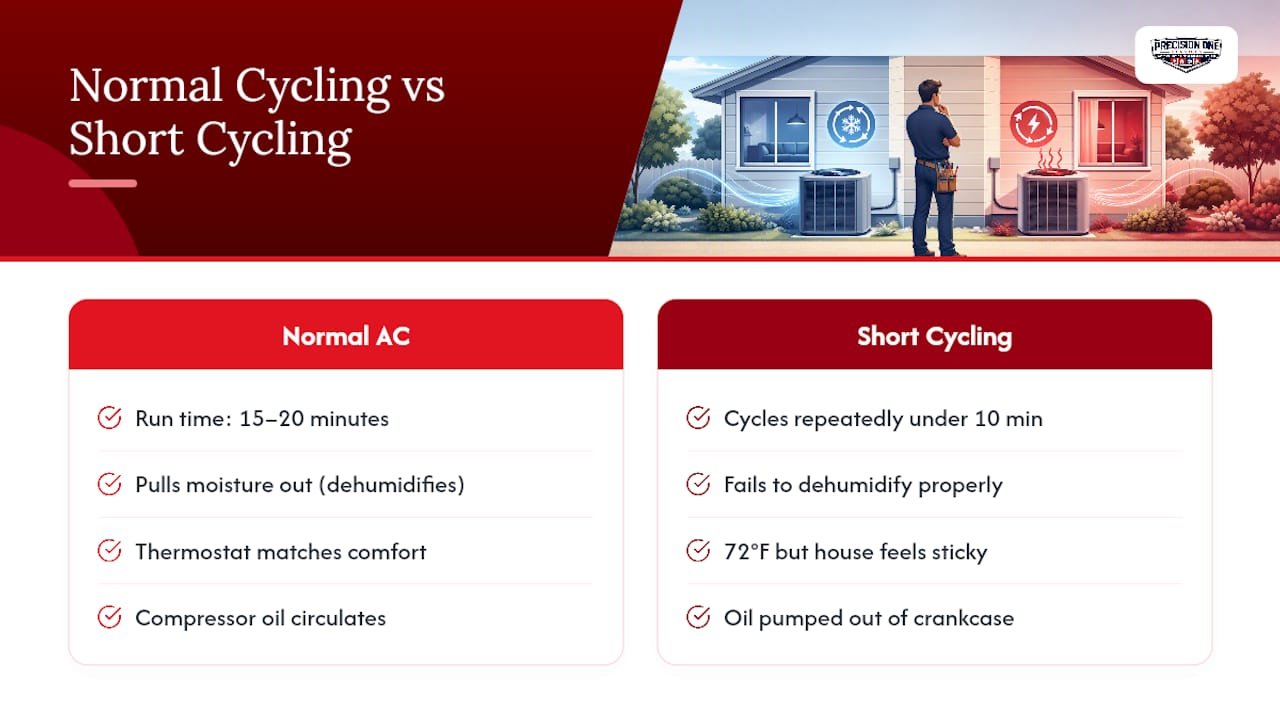
A properly running air conditioner does more than drop the temperature. It runs long enough to pull moisture out of the air, a process HVAC technicians call latent load control. That takes time. The system needs those 15 to 20 minutes to let the evaporator coil stay cold enough, long enough, to condense humidity out of your indoor air.
Statistic Callout: Cycles that repeatedly last under 10 minutes are the industry benchmark for short cycling, according to Bryant. If you can count your AC’s cycles on one hand within an hour, something is wrong.
When your system short cycles, it never gets that long enough run to dehumidify properly. Your thermostat might read 72 degrees, but the house still feels sticky. That clamminess is often the first clue homeowners notice, before they even realize the unit is cycling too fast.
There’s a mechanical cost too. Every time the compressor starts, oil inside it needs a few minutes of steady operation to circulate and lubricate moving parts properly. Frequent starts and stops can pump oil out of the compressor crankcase, starving it of lubrication over time. That’s a slow, quiet kind of damage. It doesn’t show up as a sudden breakdown right away, but it shortens the life of the most expensive part of your system.
Watch for these signs: your AC starting and stopping every few minutes, the house feeling humid despite the thermostat setting, or ice forming on the refrigerant lines outside. Any of these point to short cycling, not just a quirky thermostat.
What’s Actually Causing Your AC to Short Cycle
Most short cycling problems trace back to one of a handful of usual suspects. Work through this list in order. It’s roughly ranked from most common and easiest to fix, to less common and more involved.
- Airflow restriction. A dirty filter, closed vents, or shut dampers choke off airflow and trip the system’s safety switches.
- Frozen evaporator coil. Usually caused by the airflow problem above or low refrigerant, the coil ices over, forcing a shutdown.
- Low refrigerant from a leak. Topping off refrigerant without finding the leak just guarantees a repeat call in a few months.
- An oversized system. A unit too big for your home cools the air fast without running long enough to dehumidify, which causes chronic short cycling from day one.
- Thermostat trouble. Poor placement, dead batteries, or a miscalibrated sensor can trick the system into cycling erratically.
- Electrical failure. A failing capacitor or contactor can make the compressor start, then cut out almost immediately.
- Condenser problems. A dirty outdoor coil or a weak fan motor limits heat rejection, forcing early shutoffs.
How to Troubleshoot AC Short Cycling Yourself
Safety first: if you smell burning, see refrigerant oil residue, or notice a tripped breaker that won’t reset, stop and call a technician. Electrical faults and refrigerant leaks aren’t DIY territory.
Here’s what you can safely check on your own before picking up the phone.
- Pull and inspect your air filter. Hold it up to a light. If you can’t see through it, replace it. Most filters need swapping every 1 to 3 months, and a dirty filter is one of the most common fixable causes of short cycling.
- Walk the house and open every vent. Closed registers and shut dampers restrict airflow just as much as a dirty filter does.
- Check the outdoor unit. Clear leaves, grass clippings, and debris from around the condenser, and look for bent fins blocking airflow.
- Test your thermostat. Swap the batteries, confirm it’s not mounted near a sunny window or a supply vent, and reset it if it seems unresponsive.
- Look at the coil through the access panel. If you see ice, turn the system off completely and let it thaw before calling a technician. Running it iced over risks liquid refrigerant flooding the compressor.
Pro Tip: If a fresh filter and open vents don’t stop the short cycling within a day, don’t keep experimenting. Repeated short cycles do cumulative damage to the compressor, so a persistent problem after basic fixes means it’s time for a professional diagnosis, not more trial and error.
Filter changes and open vents resolve a surprising number of short cycling complaints on their own. If the symptoms persist, especially ice on the coil, a hissing sound, or the unit cycling every couple of minutes even with a clean filter, you’re likely dealing with refrigerant, electrical, or sizing issues that need a trained eye.
When It’s Time to Call a Licensed HVAC Technician
Call a professional right away if you notice smoke or burning odors, oily residue near refrigerant lines, a breaker that keeps tripping, or short cycling that continues after you’ve checked the filter, vents, and thermostat. These point to problems that need diagnostic tools, not guesswork.
A qualified technician will typically run through a specific sequence: checking refrigerant pressures, testing for leaks, measuring airflow, and testing electrical components like the capacitor and contactor. If nothing mechanical turns up, they’ll often perform a Manual J load calculation to check whether your system was ever sized correctly for your home in the first place.
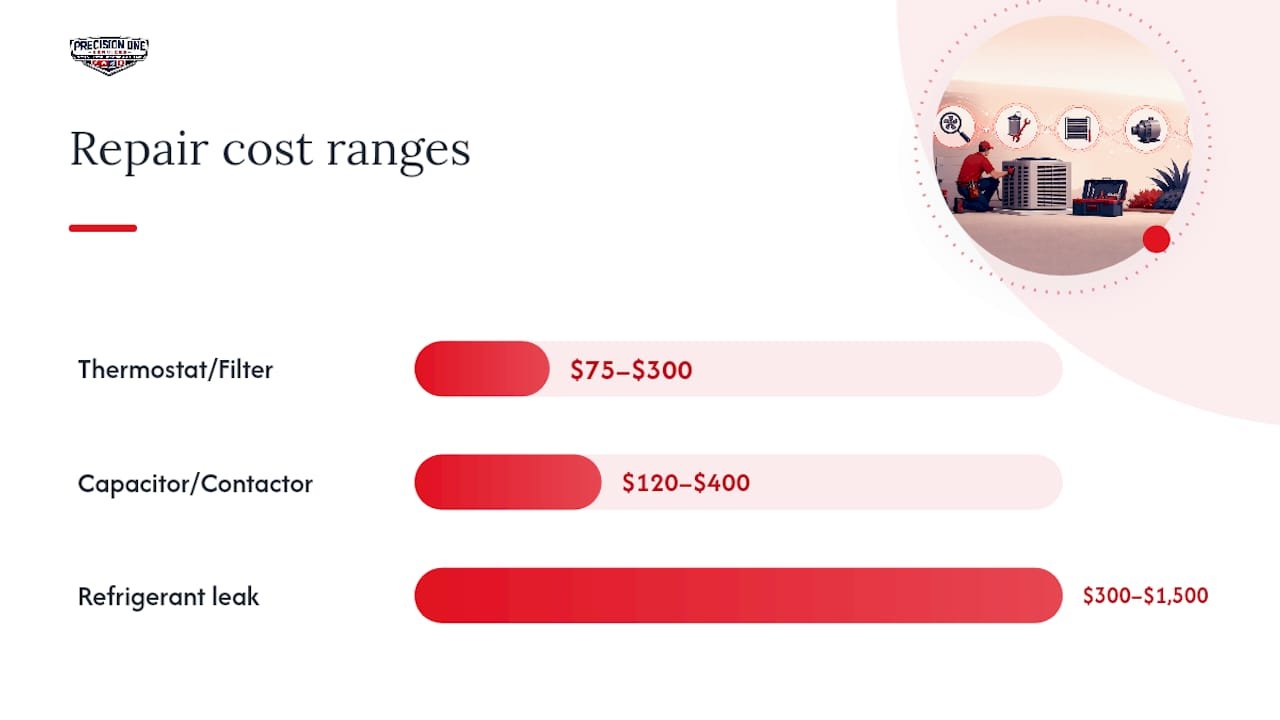
Statistic Callout: Repair costs vary widely by cause. Simple fixes like a thermostat swap or filter-related service often run $75 to $300, while a failing capacitor or contactor typically falls between $120 and $400. Refrigerant leak diagnosis and repair climbs to $300 to $1,500 or more, depending on the leak’s location and refrigerant type. Compressor replacement sits well above all of these.
Before hiring anyone, ask a few direct questions:
- Are you licensed and insured for HVAC work in this state?
- Do you offer flat-rate, upfront pricing before work begins?
- Is there a workmanship guarantee on the repair?
- Will you explain repair versus replacement options in plain terms?
If your system keeps overheating or shutting off, our guide on why your AC blows warm air covers a related set of symptoms worth ruling out, and for situations that can’t wait, same-day AC repair gets a technician to your door fast.
Building a Maintenance Plan That Prevents Short Cycling
Most short cycling problems are preventable with a consistent maintenance rhythm rather than a one-time fix.
- Replace filters on schedule. Every 1 to 3 months depending on your household. A higher MERV rating traps more particles but can restrict airflow if your system isn’t designed for it, so match the filter to your equipment rather than grabbing the highest number on the shelf.
- Book an annual tune-up. A seasonal check catches a weak capacitor or a slowly leaking refrigerant line before it forces an emergency call.
- Get your thermostat placement right. Keep it away from direct sunlight, supply vents, and drafty doorways. A remote sensor can solve apparent short cycling in rooms that run hotter or cooler than the rest of the house.
- Keep the outdoor unit clear. Clean the condenser coil, confirm the fan spins freely, and maintain a two-foot perimeter free of shrubs, mulch, or stored items.
- Consider a variable-speed system if oversizing is chronic. These units modulate output instead of blasting full capacity and shutting off, which directly addresses the oversizing problem at its source.
Pro Tip: If your ductwork or filter setup is limiting airflow chronically, pair your maintenance plan with a look at your home’s indoor air quality setup. Poor filtration and poor airflow often travel together.
For a full seasonal checklist, our guide on scheduling HVAC maintenance yearly breaks down what should happen each visit.
Our Take on Diagnosing Short Cycling the Right Way
The biggest mistake we see homeowners make isn’t skipping maintenance. It’s assuming short cycling is a minor annoyance rather than a symptom of something specific. Every cause on that checklist, from a dirty filter to an oversized unit, leaves its own fingerprint, and treating them all the same way (a quick refrigerant top-off, a thermostat reset, and hoping) just delays the real fix.
Oversizing is the cause we think gets the least attention in most homeowner guides, and it’s frustrating because it’s not something a filter change or a capacitor swap will ever solve. If a system was installed too large for the home, it will short cycle for as long as you own it, cooling fast and shutting off before it ever pulls moisture out of the air. That’s why a proper diagnostic visit always has to ask “was this sized correctly?” before jumping to smaller repairs.
Our technicians treat that question as step one, not a last resort.
— Nick
How Precision One Services Handles Short Cycling Calls
Precision One Services is locally owned and staffed with licensed technicians who diagnose short cycling with the same sequence everytime: airflow first, refrigerant second, electrical components third, and sizing last if nothing else explains it. We run this service across the Inland Empire area, with 24/7 emergency availability for the calls that can’t wait until morning.

What makes the difference for most homeowners is knowing the price before the work starts. We quote flat-rate pricing upfront, so there’s no surprise invoice after a technician spends an hour pressure testing your system. Every repair carries our lifetime workmanship guarantee, which means if something we fixed fails again, we come back and make it right at no extra charge.
If your system is cycling every few minutes and the basic checks haven’t fixed it, schedule a diagnostic visit through our AC repair services page and get a technician out to trace the actual cause instead of guessing at it.
Sources
- AC Short Cycling: Causes, Fixes & How to Prevent It — Bryant
- What Is AC Short Cycling? Causes & Troubleshooting — Carrier
- Compressor short cycling — An unrecognized problem — Copeland
- AC Keeps Turning On and Off? A Lowcountry Short-Cycling Diagnostic — Coastal Carolina HVAC
Recent Comments