Most cases of an AC not blowing cold come down to something simple: a bad thermostat setting, a clogged filter, or a tripped breaker. But if you notice ice on the coils, hissing sounds, a burning smell, or a breaker that keeps tripping, shut the system off now and call a licensed technician. Running it further risks turning a small repair into a failed compressor.
TL;DR:
- Most common causes include thermostat misconfiguration, clogged filters, and tripped breakers; these are easily checked within ten minutes.
- Signs like ice on coils, hissing sounds, burning smells, or repeated breaker trips require immediate system shutdown and professional diagnosis.
- Deep issues such as refrigerant leaks, frozen coils, or electrical failures often need licensed technicians; DIY repairs can cause further damage.
- Outdoor condenser problems stem from debris blockage, seized fans, or bent fins, reducing cooling capacity even if the system runs.
- Routine maintenance like filter changes and coil cleaning significantly improve system performance, especially during extreme heat conditions.
Table of Contents
- Why Is My AC Not Blowing Cold? Quick Triage Checklist
- What’s Really Causing Your AC to Blow Warm Air?
- How to Safely Check the Outdoor Unit and Power Supply
- When Should You Call a Professional for AC Repair?
- How Precision One Services Handles a No-Cool Call
- Why Checking Refrigerant Levels Isn’t a DIY Job
- How Does the AC Cooling Cycle Actually Work?
- A Simple Decision Tree for Diagnosing a No-Cool AC
- Does Hot Weather Make an AC Blow Less Cold Air?
- What Do AC Repairs for This Problem Typically Cost?
- The Real Lesson Behind an AC That Won’t Cool
- Get Your AC Back to Cooling Properly
- Sources
Why Is My AC Not Blowing Cold? Quick Triage Checklist
Before you assume the worst, work through this list. It takes ten minutes and solves a surprising share of complaints about an AC running but not cooling.
- Check the thermostat mode. Confirm it’s set to COOL, not just “on” or fan mode. Set the temperature several degrees below the current room reading so the system calls for cooling.
- Look at the fan setting. If it’s set to ON, the blower runs constantly, even when the compressor isn’t cooling, which can make it seem like the AC is blowing warm air even though it isn’t broken. Switch it to AUTO and see if performance changes.
- Swap the batteries. A thermostat with dying batteries can misread the room temperature or lose its program entirely.
- Pull the air filter and hold it up to a light. If you can’t see light through it, it’s restricting airflow badly enough to cause problems.
- Walk outside. When the thermostat calls for cooling, the outdoor condenser unit should kick on within a minute or two.
- Check the breaker panel and the disconnect switch near the outdoor unit. Don’t open any electrical panels, just confirm nothing has tripped.
- Open every supply vent and make sure furniture or rugs aren’t blocking airflow into the room.
Pro Tip: Feel the air coming from a vent closest to the indoor unit, then compare it to the return air grille. A healthy system usually produces a noticeable temperature drop between the two. If the air feels roughly the same temperature in both spots, something in the cooling process has failed.
What’s Really Causing Your AC to Blow Warm Air?
Once you’ve ruled out the quick fixes, it helps to understand what each deeper cause actually looks like. Manufacturer guidance from Bryant lists the same recurring culprits homeowners run into again and again: filters, thermostats, blocked condensers, frozen coils, refrigerant problems, and electrical failures.
Thermostat misconfiguration is the easiest to miss because the unit still runs. Wrong mode, a setpoint too close to room temperature, or a thermostat that’s lost calibration over the years can all make an otherwise healthy system feel broken. Sometimes it’s nothing more than someone bumping the fan switch during cleaning.
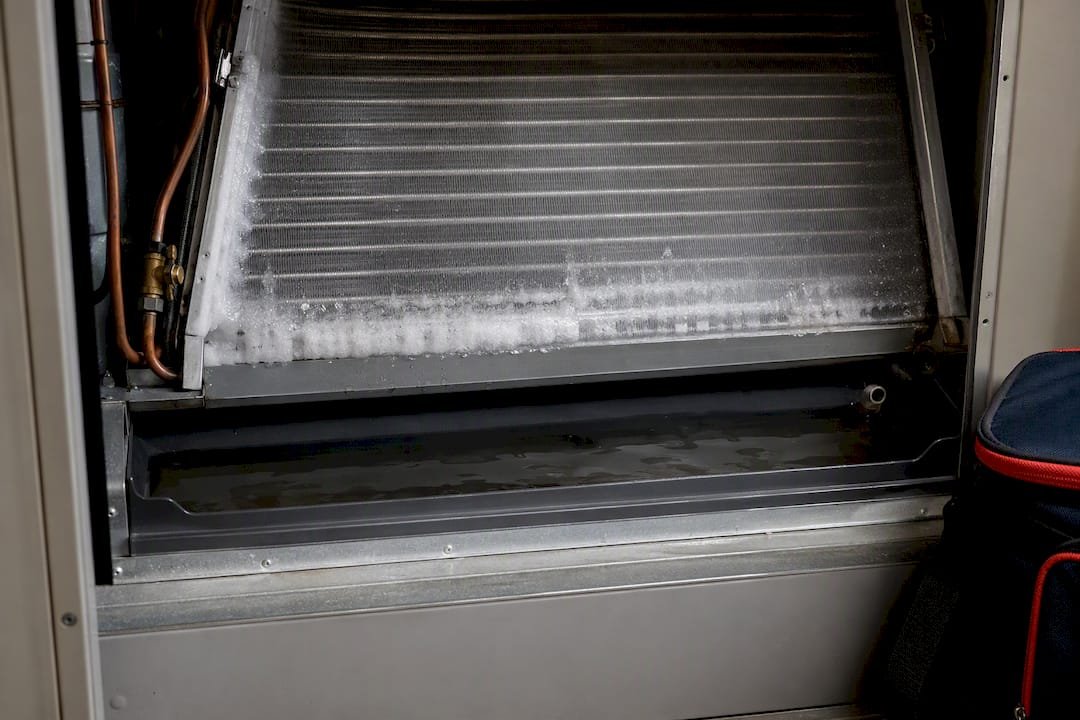
Airflow restriction starts small and snowballs. A dirty filter chokes the volume of air moving across the evaporator coil. Less airflow means less heat transfer, which means the coil gets colder than it should, past the point where condensation freezes on its surface instead of draining off. A severely clogged filter can trigger this chain reaction on its own, and once ice builds up, cooling output drops even further.
A frozen evaporator coil shows up as visible frost or ice on the indoor coil, weak airflow from vents, or water pooling around the indoor unit as the ice eventually melts. If you spot this, turn the system off, switch the thermostat fan to ON so air keeps circulating, and let it thaw for one to four hours before running it again. If it re-freezes shortly after, the root cause is either restricted airflow or low refrigerant, and it needs a professional look.
Refrigerant leaks get misunderstood constantly. Refrigerant is a closed-loop chemical. It doesn’t get “used up” through normal operation the way gasoline does in a car. If your system is low, it’s because refrigerant is escaping somewhere in the lines or coil, and Carrier’s own troubleshooting guidance is direct about this: a leak has to be found and repaired before anyone recharges the system, or you’re just paying to lose refrigerant a second time. Signs include hissing near the lines, an oily residue around fittings, and a system that runs constantly without ever quite reaching the setpoint.
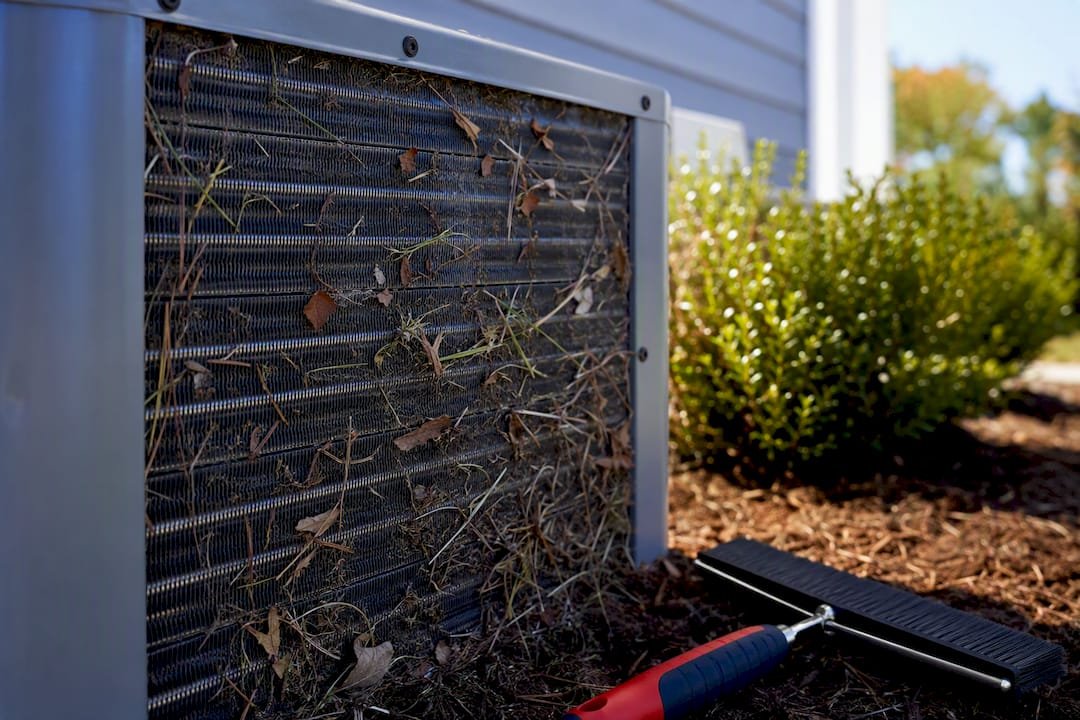
Outdoor condenser problems often hide in plain sight. Dirt, pollen, grass clippings, or overgrown shrubs blocking the coil fins prevent the unit from releasing the heat it just pulled from your house. A fan motor that’s seized or a bent fin pattern packed with debris both produce the same symptom: the compressor runs, but cooling capacity craters.
Electrical failures tend to announce themselves through sound. A clicking noise followed by silence often points to a failed start capacitor. A humming compressor that never actually spins up suggests the run capacitor has failed, or the contactor is stuck. If the outdoor fan spins but you hear no compressor sound at all, that’s a different problem than a completely silent unit, and both point toward electrical rather than mechanical failure.
Compressor failure is the outcome nobody wants. A compressor that hums loudly but won’t start, or one that trips the breaker repeatedly on startup, is usually failing internally. This is not a DIY repair under any circumstance.
One useful benchmark: a healthy central AC typically produces a supply air temperature 18°F to 22°F cooler than the return air. If that gap, known as the ΔT, drops below roughly 12°F, the refrigeration cycle is underperforming and it’s time to stop troubleshooting and call someone.
Ductwork problems round out the list. Closed registers in unused rooms, torn flex duct in the attic, or duct insulation that’s degraded over the years all bleed cooled air away before it reaches your living space, even when the AC itself is working fine.
How to Safely Check the Outdoor Unit and Power Supply
Stay clear of the fan blades and never remove an access panel. Technical diagnostic guidance from InspectApedia recommends a simple listen-and-look approach before touching anything.
- Confirm the thermostat is actively calling for cooling, then walk to the outdoor unit.
- Listen for the fan spinning along with a low compressor hum. That combination usually means the unit is trying to run.
- If the fan spins but there’s no compressor sound, suspect a capacitor or contactor issue.
- If nothing moves and you hear total silence, check the breaker and the outdoor disconnect switch. Flip the breaker fully off, then back on, once. If it trips again immediately, stop and call a technician.
- Watch and listen for sparks, a burning odor, hissing refrigerant, visible ice on the copper lines, or unusual vibration. Any of these means shut the system down completely.
Pro Tip: A breaker that trips once might be a fluke. A breaker that trips twice is your system telling you it’s drawing too much current somewhere, and repeated resets can damage the compressor further.
When Should You Call a Professional for AC Repair?
Certain symptoms mean the DIY checklist is over. Hissing near the refrigerant lines, ice that returns quickly after you’ve let the coil thaw, a breaker that trips more than once, any electrical smell, or a compressor that hums without starting all call for a licensed technician.
A technician arriving for HVAC not cooling properly will typically:
- Measure refrigerant charge and system pressures against the manufacturer’s specification.
- Run leak detection if the charge is low, rather than just topping it off.
- Test the start and run capacitors, along with the compressor’s electrical draw.
- Check duct static pressure for leaks or airflow blockages you can’t see from inside a room.
Before the visit, jot down your system’s make, model, and age, plus whatever you’ve already checked. If your unit is older and this is its second or third major repair in a few years, ask the technician for a straight comparison of repair cost versus the financing available for a full HVAC replacement.
How Precision One Services Handles a No-Cool Call
When your air conditioner runs but won’t cool, Precision One Services sends licensed technicians to diagnose the actual failure, not just guess at it. The team offers 24/7 emergency AC repair with flat-rate pricing quoted before any work starts.
- Full refrigerant leak detection and repair, not just a recharge
- Capacitor, contactor, and compressor diagnostics and replacement
- Evaporator coil and condensate line service
- Duct inspection and repair for airflow loss
Every completed repair carries a lifetime workmanship guarantee, and homeowners can ask about maintenance membership plans designed to catch these failures before they leave you without cooling on a 100°F afternoon.
Why Checking Refrigerant Levels Isn’t a DIY Job
Refrigerant sits in a sealed loop, and unlike motor oil or coolant in a car, it isn’t something you top off on a schedule. Checking the charge accurately requires gauges connected to the system’s service ports, along with knowledge of the target pressures for that specific refrigerant type and outdoor temperature. Read those pressures wrong, or connect gauges incorrectly, and you can introduce contaminants into the line or vent refrigerant that’s regulated for environmental reasons.
There’s also a diagnostic reason this matters. Low pressure alone doesn’t tell you where the refrigerant went. A technician uses electronic leak detectors, UV dye, or soap-bubble tests at joints and coil seams to pinpoint the exact leak location, because refrigerant loss always signals a leak somewhere in the system, not normal consumption. Recharging without finding that leak just delays the same problem by a few months.
What you can do at home is watch for the secondary signs: a system that runs far longer than it used to without reaching the setpoint, ice forming on the indoor coil or outdoor line, or a hissing sound near accessible refrigerant lines. None of those confirm the exact cause, but they’re enough evidence to justify calling a technician rather than waiting it out.
How Does the AC Cooling Cycle Actually Work?
Understanding the basic cycle makes it much easier to figure out where things went wrong. Refrigerant absorbs heat from inside your home, carries it outside, and releases it there, over and over, in a continuous loop.
Inside your air handler, the indoor evaporator coil holds cold, low-pressure refrigerant. Warm room air blows across it, the refrigerant absorbs that heat and evaporates into a gas, and the now-cooled air gets pushed through your ducts and out the vents.
That refrigerant gas travels to the outdoor unit, where the compressor squeezes it, raising its pressure and temperature. The condenser coil outside then releases that heat into the outdoor air, which is why the outdoor fan blows hot air, helped along by that fan. As it releases heat, the refrigerant condenses back into a liquid.
That liquid passes through an expansion valve, which drops its pressure sharply and cools it back down before it returns to the indoor evaporator coil to start the cycle again. This entire loop repeats continuously while the system runs, and every part of the troubleshooting checklist above maps to one point in this cycle. A dirty filter or blocked vent starves the evaporator coil of airflow. A dirty condenser outside prevents heat release. A bad capacitor stops the compressor from doing its job of pressurizing the gas. Once you see the cycle as a chain, it’s obvious why one weak link anywhere along it stops cold air from reaching your rooms.
A Simple Decision Tree for Diagnosing a No-Cool AC
Work through these questions in order, and stop at whichever point matches your situation.
Is the thermostat set to COOL with a setpoint below room temperature? If not, fix that first and wait fifteen minutes.
Does the outdoor unit start when cooling is called for? If it stays completely silent, check the breaker and disconnect before anything else.
Is the air filter visibly clogged? Replace it and see if performance improves within an hour.
Is there ice on the indoor coil? If yes, power off, let it thaw for one to four hours, and check the filter and vents while you wait.
Does the system run but never reach the setpoint, with only lukewarm air from the vents? That pattern, combined with a small supply-to-return temperature drop, points toward low refrigerant or a failing compressor. Both require a technician.
Do you hear hissing, smell burning, or has the breaker tripped more than once? Skip every other step. Shut the system off and call a licensed technician now.
Does Hot Weather Make an AC Blow Less Cold Air?
Extreme heat exposes weaknesses that would otherwise stay hidden. Central air conditioners are sized and rated to produce a certain temperature drop under specific outdoor conditions, usually around 95°F. Push the outdoor temperature well past that, into 105°F or 110°F territory, and even a perfectly healthy system will struggle to hit the same indoor temperature it manages easily in spring.
That’s normal physics, not a malfunction, since the condenser has to reject heat into air that’s already hot. But it also means marginal problems, a slightly dirty condenser coil, a capacitor that’s weakening, a filter overdue for replacement, tend to surface first during the hottest stretch of summer. A system that seemed fine in June can suddenly feel like it’s not cooling at all in August, simply because the ambient heat load exposed a weakness that was already there.
This is also why routine maintenance like filter changes and outdoor coil cleaning resolves so many warm-air complaints: a system running at full efficiency has more margin to handle a heat wave than one that was already compromised going into summer.
What Do AC Repairs for This Problem Typically Cost?
Repair costs vary widely depending on the part and your local labor rates, but understanding the rough categories helps you gauge whether a quote sounds reasonable.
| Repair Type | Relative Cost Level | Notes |
|---|---|---|
| Air filter replacement | Low | Often the cheapest fix available; a preventable cause if ignored |
| Capacitor replacement | Low to moderate | One of the most common outdoor unit repairs |
| Condenser coil cleaning | Low to moderate | Prevents bigger problems if done annually |
| Refrigerant leak repair and recharge | Moderate to high | Cost depends on leak location and refrigerant type |
| Contactor or fan motor replacement | Moderate | Electrical component failure in the outdoor unit |
| Compressor replacement | High | Often close enough to a new system’s cost to warrant comparing both |
Capacitor swaps and filter changes sit at the affordable end, which is exactly why the quick triage checklist above catches so many cases before they become expensive. Compressor failures sit at the other end, and on an older system, that repair cost alone is often the deciding factor in whether to repair or replace the unit entirely.
The Real Lesson Behind an AC That Won’t Cool
Most homeowners treat every warm-air complaint as a mystery, when the honest split is closer to predictable. A large share of these calls trace back to a thermostat setting, a filter nobody replaced in eight months, or a breaker that tripped during a storm. The checklist approach works because it targets the failures that are both common and free to fix.
Where conventional advice falls short is the murky middle ground. Plenty of guides tell you to “check the refrigerant” as if that’s a homeowner task, when it genuinely isn’t. Gauges, pressure charts, and leak detection belong to a licensed technician for good reason: get it wrong and you either waste refrigerant or misdiagnose a leak entirely. The same goes for capacitors and compressors. Hearing a hum instead of a start-up sound is diagnostic information, not a repair instruction.
Prioritize the free checks first, always. But the moment you see ice, smell something burning, or watch a breaker trip twice, the smartest move is stopping the system and making the call. That single decision protects a compressor that costs far more to replace than it does to service early.
— Nick
Get Your AC Back to Cooling Properly
If you’ve worked through the checklist and your air conditioner is still blowing warm air, Precision One Services is built for exactly this call. The team sends licensed technicians who diagnose the actual failure, refrigerant leak, failed capacitor, struggling compressor, and quote flat-rate pricing before any work begins, so there’s no surprise invoice waiting at the end.

Every repair comes backed by a lifetime workmanship guarantee, and because cooling failures rarely wait for business hours, service is available around the clock for the days your AC picks the worst possible time to quit. If today’s checklist pointed you toward a professional-only fix, schedule AC repair service and get a technician out to diagnose the real cause before the next heat wave arrives.
Sources
For manufacturer-specific diagnostics, see Carrier, Bryant, and Trane’s troubleshooting guide, plus InspectApedia’s technical walkthrough.
- Carrier — Why is my AC blowing hot air?
- InspectApedia — Fix an A/C or Heat Pump Unit that Blows Warm Air
- USA TODAY — Why your AC isn’t cooling and what to do about it
Recent Comments